

How to make your home smell beautiful all the time: a complete home fragrance guide
There are homes where you notice the fragrance the moment you walk in, and others where you discover it gradually as you move from one room to the next. The secret is not necessarily a stronger scent. More often than not, it is the way the fragrance has been woven into the space.
The short answer
For a home that smells beautiful all the time, start with a well-aired space and then build the fragrance in two rhythms: a discreet, continuous olfactory backdrop, created with a diffuser, and more expressive moments of scent, created with a candle.
Do not try to scent every corner, nor to reach the same intensity in every room. A beautifully scented home has variations, pauses and a certain coherence from one space to the next.
Start with the air, not the fragrance
If you are wondering how to make your home smell beautiful, the first step has nothing to do with choosing a candle or a diffuser. It starts with the air.
Air your home regularly, especially in the morning and after cooking, then let it settle back to a neutral background before you introduce fragrance.
Think of home fragrance as the final layer of a room's atmosphere. It should not mask the space, but complete it.
Expert note
Avoid burning a candle in a strong draught. An unsteady flame can lead to an uneven burn. Air the room first, then light the candle once the air has settled.
It is a simple gesture, but it changes both the experience of the fragrance and the way the candle burns.
Create an olfactory backdrop
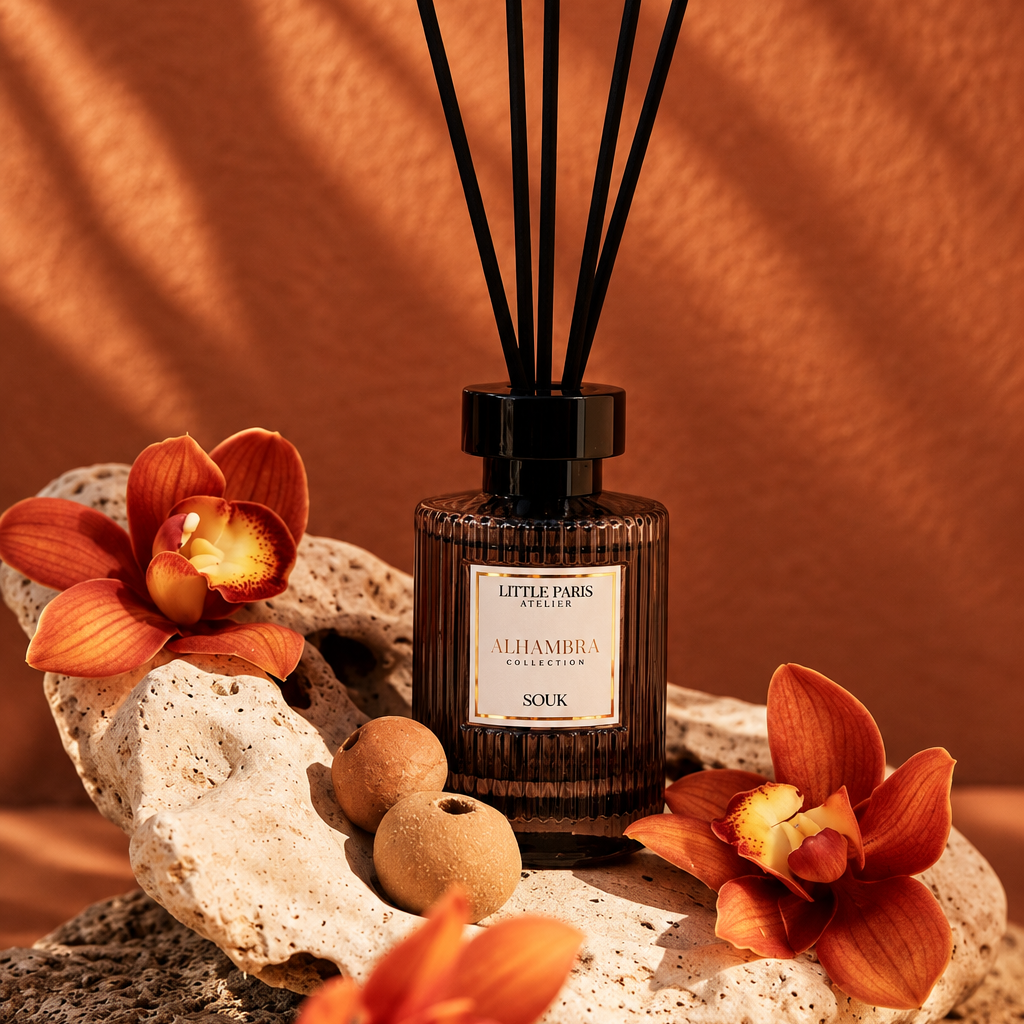
If you want fragrance to be part of your home even when no candle is lit, a reed diffuser is a good place to start.
Its role is not to dominate the room, but to create a discreet, constant presence.
A Love Letter, with Damask Rose and Agarwood, takes a floral, deep and elegant direction. It is the kind of fragrance that can give personality to a hallway or living room without depending on a particular time of day.
A well-chosen diffuser does not need to demand your attention constantly. Its fragrance can simply become part of the atmosphere.
Intensity is not the same as diffusion
When we choose a fragrance for the home, we are tempted to judge it by a single criterion: how strongly it smells.
But intensity and diffusion are not the same thing.
A fragrance can be discreet and still spread beautifully through a space, while another may seem very intense close to the source and far less present at a distance.
So do not judge a home fragrance only by how "strong" it feels. Notice how it fills the space, how present it remains in the background and how you perceive it when you walk back into the room.
Use a candle to change the atmosphere
If the diffuser builds the backdrop, the candle can mark a moment: the end of the day, a dinner, a few hours of reading or simply the shift from the rhythm of the day to that of the evening.
Precisely because it is not a permanent source, a candle lets you choose more expressive compositions and change the olfactory register of a room to suit the moment.
Cosy Morning takes a bright, aromatic direction, with lemongrass, citrus, ginger and woody accents. It is the kind of fragrance you might associate with the first part of the day, when you want a fresh, energising atmosphere.
For the evening, Patisserie, with pecan, cocoa and honey, brings a warm, comforting gourmand direction. It is a good example of a fragrance that can change the atmosphere of a room for a few hours.
If you prefer continuity, you can choose the same composition in two formats. A Love Letter as a scented candle can carry on the fragrance of the diffuser and make it more present whenever the candle is lit.
Neither option is more correct than the other. It depends on whether you want continuity or contrast.
A beautifully scented home also has pauses
One of the temptations of home fragrance is to add more scent every time we feel we can no longer smell it enough.
But fragrance also needs space.
Not every room needs the same intensity, and not every corner needs its own source of fragrance. Sometimes passing through a more neutral area makes the next fragrance easier to perceive.
This is where the dynamic of a beautifully scented home comes from: a discreet hallway, a more present living room, a calmer bedroom.
If you want to create these differences deliberately, we have explained separately the principle of scent zoning and how to scent each room differently.
You can use different fragrances in the same home
A home does not have to smell the same everywhere.
You can have a brighter fragrance during the day and a warmer one in the evening. You can keep one diffuser constant and change your candles with the season or the moment.
What matters is that the transition feels intentional.
Fragrances do not need to share the same note to work together. The link can come from the olfactory family, the texture or a natural transition from bright to warm, from green to woody or from floral to amber.
For more elaborate combinations, you will find concrete examples in our guide to scent layering and how to combine fragrances at home.
Where you place the diffuser matters
Where you place a diffuser can change the way its fragrance is felt in the room.
Avoid direct sunlight and placing it right next to radiators or other strong heat sources, which can speed up evaporation. A spot with a gentle flow of air can help the fragrance spread through the space.
And do not assume every composition will behave in the same way. A bright, citrus fragrance can have a different presence from one rich in wood, amber, vanilla or gourmand notes.
The number of reeds can be adjusted to the intensity you want and the character of the space.
Worth remembering
Start softly and adjust. It is easier to gradually build up the presence of a fragrance than to begin with a space that is too heavily scented.
Let the candle develop its fragrance
The way a candle smells straight from the vessel and the way it scents a room once lit are two different experiences.
As the wax warms and a pool of liquid wax forms, the fragrance begins to diffuse into the space. That is why you should not judge a candle's intensity by its first few minutes of burning.
Especially during the first burns, let the candle form a melt pool that is as even as possible and follow the recommended burn time. Repeatedly burning it for very short periods can encourage tunnelling around the wick.
Check the wick before each lighting, too. Removing the burnt part, as described in the candle's instructions, helps keep the flame more controlled.
Expert note
When you try a new candle, do not focus on intensity alone. Notice also how the composition changes as it burns. Some facets of the fragrance can become more evident when warm, and the experience in the room can differ from the one you have when you smell the cold wax directly.
Why, after a while, you stop smelling your own home
You can walk into a home and notice its fragrance immediately, while the person who lives there barely perceives it any more.
The phenomenon is called olfactory adaptation. When we are exposed to the same smell for a while, our sensitivity to it can temporarily decrease.
This does not automatically mean the diffuser has stopped working or that the fragrance has disappeared.
Before you increase the intensity or add another source, step out of the space for a while and notice the fragrance when you come back. Sometimes you will perceive it again straight away.
And sometimes the best test is very simple: ask someone who has just walked in.
Worth remembering
A successful home fragrance does not have to be something you notice every second. It can simply become part of the way your home feels.
Let the fragrance follow the rhythm of your home
A home does not feel the same in July as it does in November. Nor does its fragrance have to stay the same.
In summer, bright, green, citrus or airy compositions suit the rhythm of the season naturally. With autumn, woody, amber, spicy or gourmand fragrances find their place more easily.
There is no need to change the whole olfactory identity of your home. Sometimes it is enough to keep the diffuser you love and change the candle.
For the current season, you will find more ideas in our guide to autumn home fragrances and the notes that suit the season.
The principles of a beautifully scented home
Start with the air. Fragrance is at its most beautiful in a well-aired space.
Build a backdrop. Use a diffuser for continuity, not for maximum intensity.
Change the atmosphere. Let a candle mark particular moments of the day.
Leave space between fragrances. Not every room and every corner needs the same intensity.
A home that smells beautiful is not one where the fragrance announces itself every second.
It is one where you notice it as you walk in, rediscover it from time to time and, given enough time, begin to associate it with the place itself.
Discover Little Paris Atelier
Fragrance that becomes part of home
Scented candles and room diffusers made in our Bucharest atelier, for spaces where fragrance is not just a detail, but part of the atmosphere.
Discover our scented candle collectionFor a discreet, continuous fragrance, you can also explore our room diffuser collection.
Frequently asked questions about home fragrance
How do I make my home smell beautiful all the time?
Start by airing your home regularly, then build the fragrance in two rhythms. A diffuser can create a discreet, continuous olfactory backdrop, while a candle can add more presence at certain moments of the day. Not every room needs to be scented at the same intensity.
Why can I no longer smell the fragrance in my own home?
It may be olfactory adaptation. Continuous exposure to the same smell can temporarily reduce your sensitivity to it. Before increasing the intensity, step out of the space for a while and notice the fragrance when you return.
Where should I put a room diffuser?
Choose a spot away from direct sunlight and strong heat sources. An area with a gentle flow of air can help the fragrance spread through the room. The ideal position also depends on the layout of the space and the character of the fragrance you have chosen.
How many diffusers do I need?
There is no universal number. The size and layout of your home, the airflow, the fragrance you choose and the intensity you want all influence the result. Start with a single source in a key area and add another only if the space calls for it.
Can I combine different fragrances in the same home?
Yes. They do not need to share the same note. They can be linked by olfactory family, by character or by a pleasant transition between them. For more elaborate combinations, you can use the principles from our guide to scent layering.
Is a candle or a diffuser better for scenting the home?
They play different roles. A diffuser offers continuity, while a candle lets you introduce fragrance at particular moments and change the atmosphere of a room. That is exactly why the two formats complement each other so well.


