

What is scent layering and how to combine fragrances at home
Layering does not mean more fragrance. It means fewer decisions, made better: one shared direction, two different intensities and a clear rule for what happens at the threshold between rooms.
The short answer
Scent layering at home means the deliberate overlapping of two or more sources of fragrance, so that the result feels coherent rather than heavy. Choose compositions linked by an olfactory bridge, keep a single dominant source in each room and work with different intensities. The aim is not for every fragrance to smell the same, but for the passage from one to the next to feel natural.
What scent layering is and why it works
In personal perfumery, layering means wearing two compositions together. At home the principle is similar, except that the variable is no longer the skin, but the space.
A diffuser in the hallway, a candle in the living room and a softer scent in the bedroom are not perceived separately. As you move through the home, transitions appear between them.
Successful layering does not mean filling every room with fragrance. It means creating a certain olfactory continuity, even when each space has its own atmosphere.
Three simple rules for successful layering
1. The olfactory bridge rule
Two fragrances do not need to share the same note to work together. It is enough for an olfactory bridge to exist between them: a common note, a related family or simply a natural transition, from green to woody, for instance, or from fresh to warm.
Think of layering as a transition, not a match.
2. The single leading voice rule
In any one room, a single source should lead. Any others stay in the background. Two very intense fragrances used at the same time in the same space are harder to balance, even if each works beautifully on its own.
3. The intensity rule
Not every room needs the same intensity. A hallway can carry a more noticeable olfactory presence, while in the bedroom a softer diffusion is usually more comfortable.
Expert note
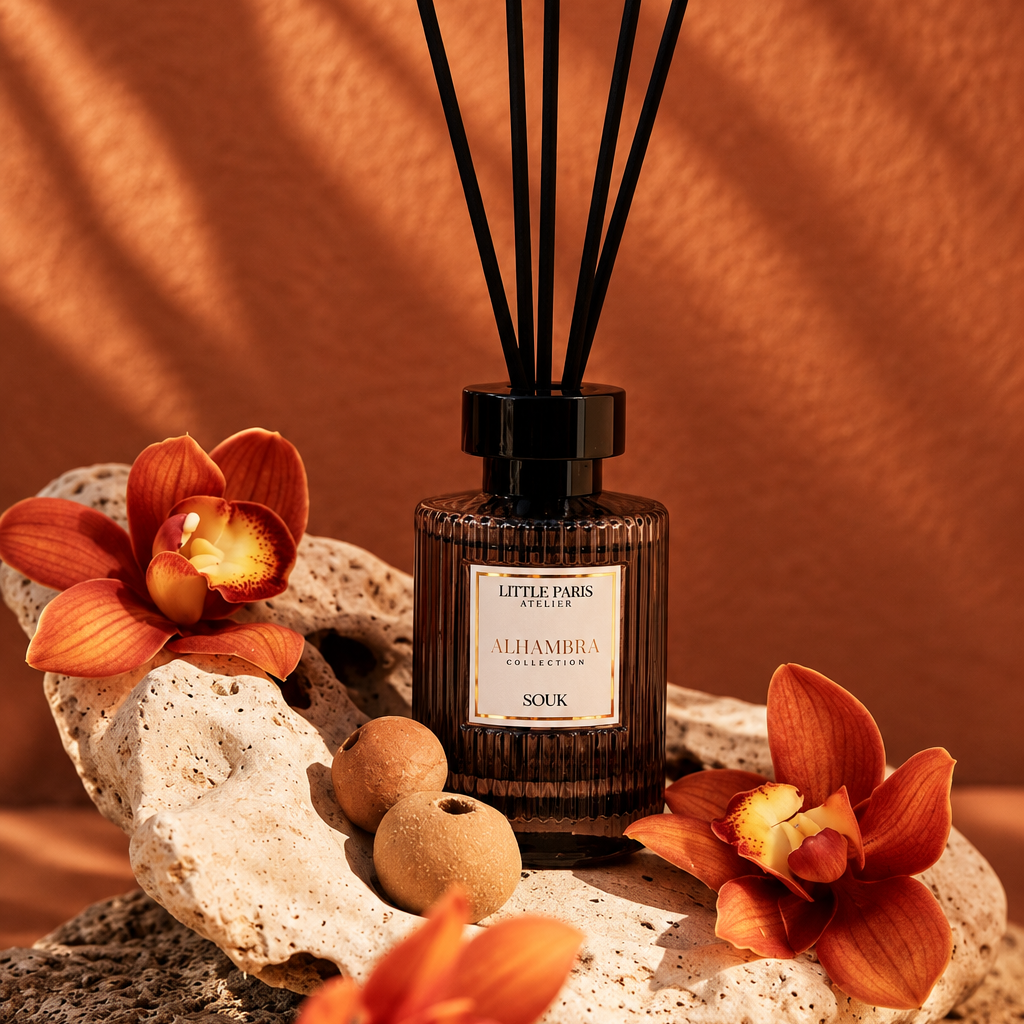
Layering is often easier to control across formats. A diffuser creates a continuous olfactory backdrop, while a candle adds a more pronounced presence for as long as it is lit. If the two compositions are connected olfactively, the result can gain depth without overwhelming the space.
Four ways to layer scent at home
| Type | How it works | Difficulty |
|---|---|---|
| By format | A diffuser in the background, a candle as an accent in the same room | Easy, the safest place to start |
| By room | Different directions, linked by an olfactory bridge | Medium |
| By moment | The same room, a different fragrance in the morning and in the evening | Easy |
| By season | The same direction, with different intensities and textures | Easy |
Combinations that work
Green and aromatic + woody amber
A Herbes d'Or diffuser, with sage, petitgrain and lemon, in the hallway can be followed by Opéra, a warmer, woody and amber composition, in the living room. The olfactory bridge does not come from an identical note, but from the natural transition from green and luminous to warm and deep.
Warm floral + bright citrus
A May in Bloom diffuser, with linden blossom and honey, can be paired with Maison d'Oranger, with neroli, mandarin and yuzu. The first is more floral and velvety, the second brings light and freshness, and the transition stays delicate.
Morning and evening in the same living room
Layering does not always have to be simultaneous. Cosy Morning, with lemongrass, ginger and vanilla, can set the tone in the morning, and in the evening the same room can shift towards a woodier or amber composition.
Sometimes the most beautiful layering is not two fragrances used at the same time, but the way the atmosphere of a room changes over the course of the day.
Combinations that are harder to balance
Two very intense fragrances in the same room
Even when they belong to compatible families, they can end up competing instead of complementing each other.
Two very different directions in an open-plan space
Without a transition between them, the result can feel fragmented. In an open-plan space it is simpler to work within the same family or with a clear olfactory bridge.
Heavily gourmand fragrances next to cooking smells
In the kitchen, food aromas are already present, and a sweet, intense fragrance can make the space feel heavy. Citrus, green or aromatic directions are usually easier to blend in.
Too many sources at once
If you can pick out every product separately the moment you walk into a room, there are probably too many. Successful layering should feel like an atmosphere, not a list of fragrances.
A simple plan for a flat
You do not need fragrance in every corner of your home.
In the hallway, use a green, citrus or aromatic diffuser to create the first impression. In the living room, a woody or amber candle can become the evening accent. In the bedroom, keep the intensity softer, and in the bathroom you can continue with a fresh, green or mineral direction.
In an open-plan space, simplify. Choose a single dominant olfactory direction and vary the intensity and format rather than introducing many different fragrances.
If you would like to build combinations from Little Paris Atelier fragrances, explore our scented candle collection and our selection of room diffusers.
Discover Little Paris Atelier
Two fragrances, one atmosphere
Scented candles and room diffusers made in our Bucharest atelier, for spaces that deserve an olfactory identity of their own.
Frequently asked questions about scent layering
What does scent layering mean at home?
It means the deliberate use of two or more sources of fragrance to create a coherent atmosphere. The fragrances do not need to be identical, but it helps if there is an olfactory bridge between them.
Can I light two different candles at the same time?
Yes, but it is easier to balance if one of them is softer or if the fragrances share a clear olfactory link. Two very intense compositions can compete in the same space.
How do I combine a diffuser with a candle?
Let the diffuser create the olfactory backdrop and use the candle as an accent when you want a more present atmosphere. Choose two compositions that are connected olfactively, without necessarily being identical.
What should I do in an open-plan space where the kitchen opens onto the living room?
Keep a single dominant olfactory direction and vary the intensity or format. In an open space, fragrances inevitably meet, so simplicity usually works best.
How many sources of fragrance are too many?
There is no universal number. The size of the space, the intensity of the fragrances and the distance between them all matter. If you perceive several competing fragrances rather than a single atmosphere, that is a good sign it is time to simplify.


