
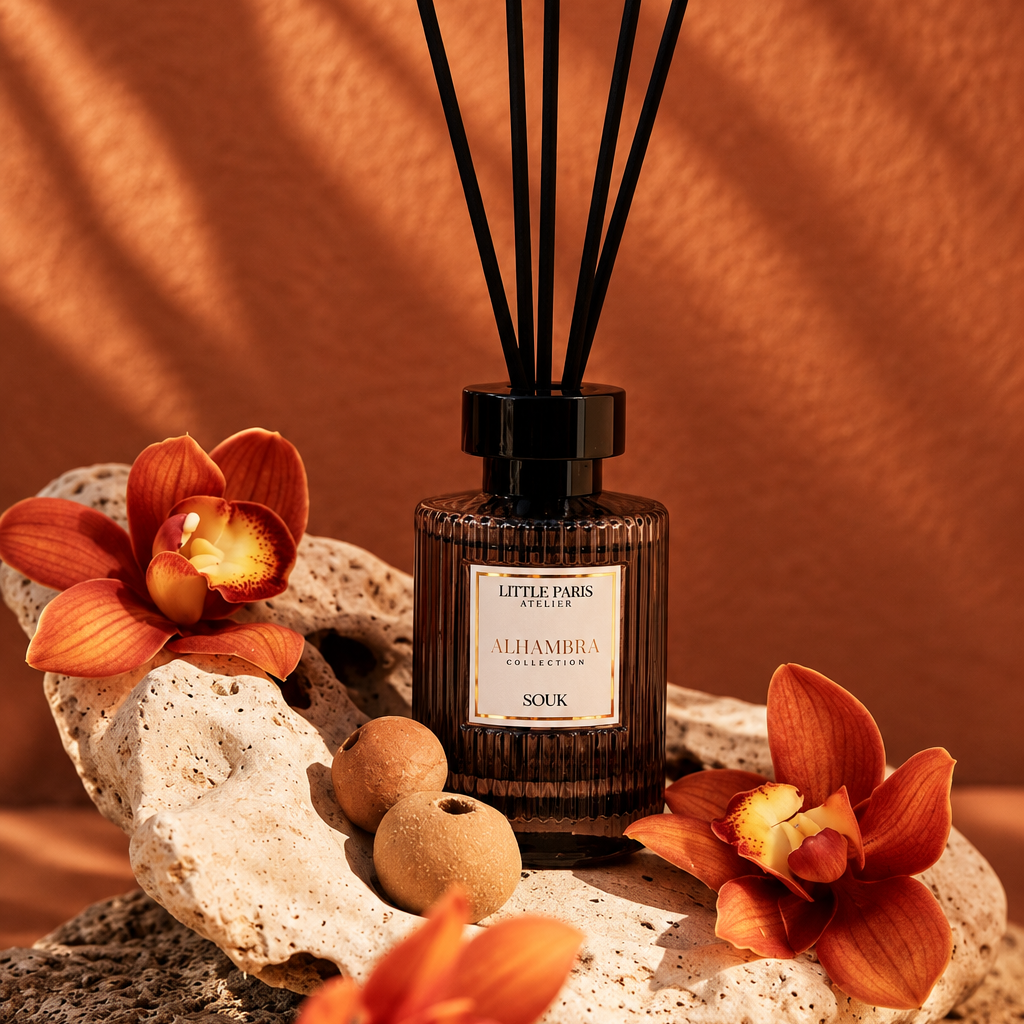

Scent as the signature of a space: how to build an olfactory identity
Every space has its own language. Materials, light, music, objects and the way an interior is built say something about it before anyone explains its story.
Fragrance can do the same.
When it is chosen with the same intention, fragrance is no longer just a pleasant smell in the background. It becomes an olfactory signature, an invisible extension of the identity of a place.
This principle is not reserved for grand hotels. It can work just as naturally in a boutique hotel, a guesthouse, an Airbnb, a restaurant, a showroom, a studio or a shop.
The short answer
A signature scent is a recognisable olfactory direction, chosen to support the identity of a space.
It is not simply about "smelling nice". It means the fragrance tells the same story as the interior, the light, the materials and the atmosphere of the place.
For a business, the question is not only "which fragrance do we like?", but above all "how do we want people to feel when they walk in?"
Start with the brand, not the fragrance
Before choosing between citrus, woods, florals or amber, describe the space in three words.
A cottage might be natural • calm • tactile
A boutique hotel might be intimate • sophisticated • sensual
An Airbnb by the sea might be bright • relaxed • Mediterranean
A concept store might be contemporary • artistic • unexpected
Those three words become a filter for the fragrance.
A natural, calm identity might lean towards green, aromatic and woody notes. A bright, Mediterranean one might lead to citrus, neroli and aromatic herbs. An intimate, sophisticated space can carry woods, amber, tonka, leather or spices.
Fragrance does not stand apart from the identity of a place. It continues it.
Expert note
A successful signature scent is not necessarily the owner's favourite fragrance. It is the fragrance that feels natural in that space.
If the interior, the light and the fragrance tell completely different stories, the experience can feel less coherent, even if each element is beautiful on its own.
Three spaces, three olfactory directions
Let us take three examples.
A bright, contemporary, relaxed space, such as a coastal boutique hotel or an Airbnb with plenty of natural light, might go in a floral citrus direction. Maison d'Oranger, with Neroli, Mandarin and Yuzu, has a fresh, luminous character.
For a hotel, bar, showroom or studio with a more sensual, tactile identity, the direction can be completely different. In His Arms, with its aromatic, woody and warm structure, moves into deeper, more intimate territory.
And an expressive, elegant, memorable space can carry a floral with more personality. Tuberose, with Tuberose, Blackcurrant and Amber, is an example of a floral direction with real presence.
There is no "correct" olfactory family for hospitality. What matters is the relationship between the fragrance and the identity of the place.
Think of fragrance along the guest's journey
One of the most common mistakes is treating the whole space in the same way.
But a guest's experience follows a route.
Hotel: entrance → reception → lobby → corridor → room
Showroom: entrance → main space → consultation area
Restaurant: entrance → bar → dining room
Not all of these zones need the same intensity, nor necessarily exactly the same composition.
The entrance can introduce the olfactory identity. Shared areas can continue it. Spaces where people spend many hours can remain more discreet.
A hallway you pass through in a few seconds and a hotel room where you sleep for eight hours are two completely different contexts.
The principle is close to what we call scent zoning: fragrance is planned according to the role of each zone, rather than distributed identically everywhere.
Worth remembering
More fragrance does not mean a more memorable experience.
In a commercial space, dosage is part of the olfactory design. Fragrance should contribute to the atmosphere, not become the only thing the customer notices.
For small properties, it can be more effective to build the olfactory identity in a few key points than to try to scent every square metre.
Diffuser or candle?
They play different roles.
A diffuser works well when you need continuity: reception, hallway, showroom, waiting area or shared space.
A candle creates a moment rather than a backdrop. It can change the atmosphere of a lounge, a bar or a supervised area where the ritual of lighting it is part of the experience.
In guest rooms, the experience should not be built around a candle that has to be lit. There, safety and ease of use matter more than ritual.
Consistency makes a fragrance recognisable
If a space smells of citrus today, intensely gourmand next week, and then switches abruptly to a completely different floral direction, it is hard to build an identity.
That does not mean the fragrance must stay unchanged all year.
You can have seasonal variations while keeping the same character. A green, bright identity can become more citrus in summer and woodier in autumn. A warm, sophisticated one can become more transparent in the warmer months and more ambery in winter.
An olfactory signature is not necessarily a single fragrance. It is a direction.
When the fragrance goes home with the guest
This is where things become even more interesting.
The fragrance of a space does not have to exist only while the guest is there.
A boutique hotel can turn the olfactory identity of its lobby into a candle guests can take home. A showroom can extend the fragrance of the space through a gift offered to clients. A restaurant, studio or concept store can create its own candle or its own diffuser.
At that moment, fragrance is no longer just ambience.
It becomes a brand object and a memory of the place.
For a business, this is perhaps the most interesting aspect of a signature scent: the chance for the experience to continue after the guest has left.
Little Paris Atelier for business
What would your space smell like?
If you run a hotel, a guesthouse, an Airbnb, a restaurant, a showroom or another space and want to build its olfactory identity, we can explore the right direction together.
From choosing the fragrance for the space to candles or diffusers created for your brand, the project can carry the same olfactory story across several forms.
Tell us about your spacebonjour@littleparis.ro
And at home?
The principle stays the same, only the purpose changes.
A hotel builds an identity for the people who cross its threshold. At home, you build the atmosphere for yourself.
You no longer need to think about a brand or a customer experience, but about how you want your own space to feel.
If you are interested in the residential side, we have written separately about how to make your home smell beautiful all the time, as well as how you can use scent zoning and fragrance layering to build the scent of a home.
The principles of an olfactory signature for a space
Start from identity. Define the place before you choose the fragrance.
Think about the experience, not just the ingredients. "Calm and bright" sometimes says more than "I want neroli".
Dose according to the space. The right intensity for an entrance can be too much for a bedroom.
Keep a recognisable thread. You can change the fragrance without losing the identity.
Let the fragrance complete the place. It does not have to be the first thing someone notices to become part of what they remember.
Fragrance as part of a brand's identity
Just as we choose the materials, light, music or objects in a space, we can also decide what olfactory atmosphere we want to build.
Not so that a hotel "smells nice".
But so that the fragrance feels as if it belongs to that hotel.
And perhaps that is the difference between scenting a space and building an olfactory signature.
Fragrance does not have to merely decorate a place. It can become part of its identity.
Frequently asked questions
Which fragrance suits a hotel or a guesthouse?
There is no universal fragrance. The choice should start from the identity of the property, its interior, its context and the atmosphere you want to create. In spaces designed for many people, dosage is as important as the choice of fragrance.
How do I choose a fragrance for an Airbnb?
Describe the property in a few words and look for an olfactory direction that continues the same atmosphere. A minimalist city flat may call for a different fragrance from a cottage or a holiday home by the sea.
Should the whole hotel smell the same?
No. You can keep the same olfactory direction and adapt the intensity or composition to each zone. Coherence matters more than uniformity.
How do you scent a commercial space without the fragrance being too strong?
Start with a few key zones and a moderate intensity. Observe how the fragrance behaves in the space before adding other sources. Areas where people spend a lot of time can stay more discreet.
What is scent branding?
Scent branding is the intentional use of fragrance as part of a brand's identity and experience. Instead of choosing a fragrance simply because it smells pleasant, you choose it for its relationship with the space, the atmosphere and the image the brand wants to convey.


