

Damask Rose in Perfumery: History, Scent and Elegance
The Damask rose is not one ingredient among many. It is the standard. The measure against which every other rose in perfumery is compared and, more often than not, found simpler.
The short answerThe Damask rose (Rosa damascena) is one of the most valuable raw materials in perfumery, grown mainly in Bulgaria, Turkey and Morocco. It is distinguished by a velvety, rich olfactory profile: a full floral, slightly honeyed, spiced with hints of clove and pink pepper, entirely different from the ordinary garden rose. Because extraction is so laborious and the yield so small (3,000 to 5,000 kilograms of petals for a single kilogram of oil), it is one of the most precious natural ingredients in the entire perfume industry.
Rosa damascena: the history of a royal ingredient
The name says it all: rosa damascena means, quite literally, the rose of Damascus. Native to the Middle East, this variety of rose has been cultivated and used in ritual across the Arab world for more than two millennia. Rose water was used in the mosques of Baghdad, in the imperial Ottoman kitchens and in the ceremonial cleansing of the Kaaba in Mecca, a constant presence in both religious and everyday life.
It was the Crusaders, returning from the Levant in the thirteenth century, who brought the Damask rose into the gardens of Europe. Old French natural history books call it "la rose de Damas", and in Elizabethan England it was grown for the rose water served at the royal table. Five centuries later, the perfumers of Grasse would make it one of the pillars of modern perfumery.
Today the world centre of Rosa damascena cultivation has moved to Bulgaria's Rose Valley, an area of around 150 square kilometres near the town of Kazanlak, which produces roughly 70% of the world's rose oil. Turkey (the Isparta region) and Morocco (the Dades Valley) account for most of the rest. Bulgaria exports rose otto (the essential oil obtained by steam distillation) and rose absolute (obtained by solvent extraction), both used in fine fragrance.

Rosa damascena in full bloom, in the region that supplies most of the rose oil used in perfumery worldwide.
Why the Damask rose is so valuable in perfumery
Rare, complex, hard to obtain, difficult to imitate faithfully: these are the four qualities that, in perfumery, define an exceptional raw material. The Damask rose has all of them, in a way matched only by oud, Grasse jasmine and natural ambergris.
Rarity: a single month a year
Rosa damascena blooms for only three to four weeks a year, normally in May and the first days of June. Outside this window, the plant does not produce flowers suitable for oil. This means the entire world supply of rose otto depends on a few dozen days in which the weather has to cooperate: too much heat opens the flowers too quickly, too much rain washes the scent away. Good years and poor years show up directly in the annual price of the oil.
The harvest: it begins an hour before dawn
Picking starts at four in the morning, by torchlight, in the cold dew. The petals are gathered by hand, one by one, without haste and without crushing. By sunrise the sacks must already be at the distillery, because as the morning light arrives the concentration of oil in the petals drops quickly. None of this can be mechanised: any early bruising or any delay costs directly in yield and in quality.
Extraction: copper stills and two stages of distillation
In Bulgaria, traditional distilleries use copper alembics and a two-stage process: a first pass that yields rose water, followed by a redistillation to obtain the concentrated oil. The process takes hours, and the yield is so small that a single small 10 ml bottle of pure rose otto represents the work of more than 30 kilograms of hand-picked petals.
Alongside it there is solvent extraction, which produces rose absolute. It is more efficient at capturing the heavier molecules and the richer side of the rose, but the trade-off is a fattier note and a different kind of complexity. Both extracts coexist in modern perfumery: rose otto for transparency, rose absolute for density.
Yield and olfactory complexity
Producing one kilogram of rose essential oil (rose otto) takes between 3,000 and 5,000 kilograms of fresh petals. That arithmetic explains the price: pure rose otto can exceed 10,000 euros per kilogram, making it one of the most expensive natural ingredients in the world of perfume.
Where a synthetic rose fragrance oil may contain 10 to 15 active molecules, natural Rosa damascena oil contains more than 400 identified chemical compounds, many in minute concentrations yet perceptible to the nose. This natural cocktail is the reason no laboratory reconstruction has yet managed to imitate perfectly the feeling of Bulgarian rose. Modern synthetics (Rose Oxide, Damascones, Damascenones) approximate some of its facets, but the way it evolves on skin remains the exclusive signature of the natural material.
Luxury positioning: a statement of quality
When a perfumer at a luxury house decides to use natural rose otto or rose absolute instead of synthetic equivalents, the decision is both technical and philosophical. Technical, because the olfactory result cannot be achieved any other way. Philosophical, because it is a form of respect for the ingredient and for the tradition of perfumery. Chanel, Guerlain, Amouage, Frederic Malle, Maison Francis Kurkdjian, Le Labo and Parfums de Marly are known for using Bulgarian or Turkish oil in their finest compositions. In home fragrance, the same choice sends the same message: the ingredient is treated as the lead character, not as a decorative accent.
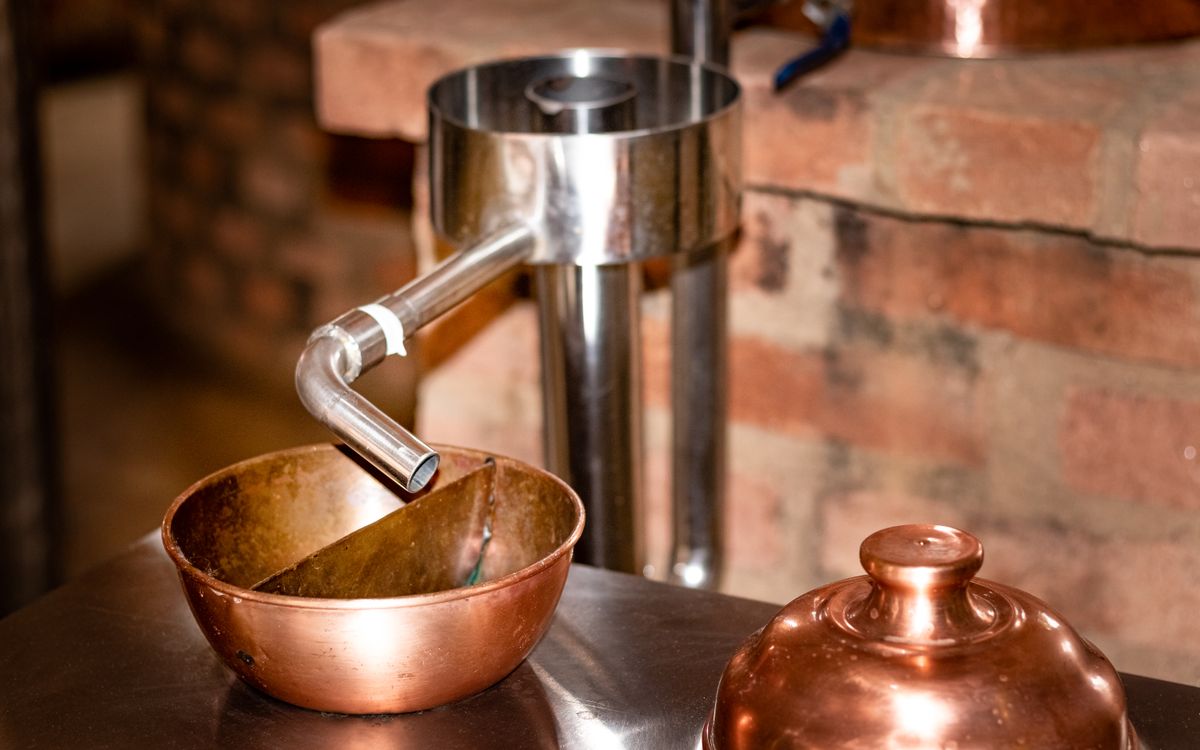
Traditional copper alembics in which, over two stages of distillation, rose petals become pure rose otto.
What the Damask rose smells like
The first surprise for anyone smelling pure Rosa damascena for the first time is its complexity. It is not simply floral. It is floral, honeyed, gently spiced, green and velvety, all at once, in a sequence that unfolds on skin and in the air.
The floral core
The heart of the scent is, of course, floral, but not a simple floral. It is a floral that is luminous on the surface and deep at the centre, with a density you will not find in classic garden flowers. Its chemistry explains this texture: the Damask rose contains geraniol and nerol (fresh, floral notes), citronellol (rounded, softly rosy), linalool (a soft floral), eugenol (a clove-like, spicy note) and rose oxide (the iconic rose character, specific and instantly recognisable).
Depth: a honeyed note beneath the floral
After the first few seconds, the Damask rose reveals a slightly fruity note, reminiscent of linden honey, followed by a warm woody background. This three-stage evolution (fresh, honeyed, warm and woody) is why it is used as a heart note in complex olfactory pyramids: it provides structure, yet can be supported by the base.
Freshness: a discreet green note in the opening
Its hidden quality, often overlooked, is freshness. Despite its honeyed warmth, the Damask rose has a green, almost chlorophyll-like clarity in its first moments, the sensation of an intact petal cut at sunrise. This green note is why the floral does not saturate the air but opens it up.
The spicy facets
Eugenol and phenylethyl alcohol give the Damask rose a subtle spicy dimension, often compared to clove, pink pepper or an airy cinnamon. These spicy nuances form the natural bridge between the floral and oriental families, which is why the Damask rose pairs so fluently with oud, amber and spices.
Emotional associations
In almost every tradition that uses it, the Damask rose is culturally associated with tenderness, intimacy, ceremony and a beautiful nostalgia. It is not a note of the moment but a note of memory. As we explained in our article on the Proust effect, smell is the only sense with direct access to the limbic system; and the rose, because it is present in so many human rituals, is one of the most effective triggers of emotional memory.

The petals of a Rosa damascena bloom, source of the more than 400 natural compounds that make up the ingredient's unique olfactory profile.
Damask rose vs Centifolia rose: two florals, two interpretations
In perfumery, two varieties of rose dominate the perfumer's natural palette: Rosa damascena (the Damask rose) and Rosa centifolia (the May rose, or "Grasse rose"). They are grown in different regions, processed in different ways and produce scents with completely different personalities.
| Characteristic | Rosa damascena | Rosa centifolia |
|---|---|---|
| Where it is grown | Bulgaria, Turkey, Morocco | Grasse (France), Morocco |
| Petals per flower | ~30 petals | ~100 petals ("centi-folia") |
| Olfactory profile | Warm, honeyed, spicy, velvety | Delicate, powdery, honey-fruity, airy |
| Character | Assertive, opulent, sensual | Discreet, timeless, contemplative |
| Classic use | Oriental compositions, gourmands, unisex fragrances | Classic florals, chypres, traditional feminine fragrances |
| Feeling it evokes | Warm, opulent, oriental | Airy, classic, traditionally French |
Rosa damascena sits closer to the warm, honeyed oriental profile, while Rosa centifolia is more delicate, powdery and airy. Neither is better than the other: they are two different readings of the same floral family, and they rarely meet in the same composition, because each demands a different olfactory architecture around it.
In contemporary perfumery, the Damask rose is the preferred choice for compositions that want to draw a clear line back to the past: unisex fragrances, modern oriental structures, launches that aim to be memorable. Centifolia remains the refuge of the classic floral, for fragrances built with finesse and for those who value discretion.
One more useful comparison is between Bulgarian Rosa damascena and "Turkish rose" (grown around Isparta). Technically, they are the same species. The difference comes from soil, altitude and distilling tradition: Turkish oil is generally richer in citronellol, which gives it a slightly sweeter, fruitier note than the Bulgarian version. Professionals tell them apart, but to the amateur nose the difference is almost imperceptible.
Expert noteThere are two main types of Rosa damascena extract: rose otto, obtained by steam distillation, cleaner, cooler and more transparent in character, and rose absolute, obtained by solvent extraction, richer and waxier. Fine fragrance relies mostly on rose absolute for its density. In oriental compositions, rose absolute is often combined with oud, sandalwood or amber to build truly memorable structures.
The mood and emotion of the Damask rose
The scent of a flower is rarely just a scent. It is a context, a state of mind, a memory. The Damask rose, more than other florals, has this ability to conjure whole scenes.
The atmosphere it creates
A room scented with Damask rose feels more velvety, calmer and, paradoxically, more present. Its steady diffusion and honeyed profile tend to slow the pace of conversation: the air grows denser, the light seems softer, voices naturally drop in tone.
The emotions it evokes
The emotions culturally linked to the Damask rose are often described as tenderness, intimacy, serene nostalgia, mature romance, contemplation and gratitude. None of them is loud. They are emotions that surface at important moments: a long dinner, a weekend with someone you love, a conversation you have been waiting a long time to have.
Who loves the Damask rose
The Damask rose rarely wins people over at first meeting. It asks for a certain olfactory maturity and a willingness to stay still for a few minutes and listen. Over time, those who choose it form a sort of quiet community, with a few traits in common.
The fragrance lover's profile
The Damask rose tends to be the choice of second-generation collectors, people who have already passed through their sugary and fresh phase and discovered that the most pleasing fragrances are not those that grab your attention, but those you notice the second time. There is also an exception: those who come straight to it, guided by a family memory or a journey to the East, and stay with it for life.
The emotional profile
It generally attracts introspective, ceremonial personalities. Those who choose it tend to do so for themselves rather than to impress: to mark a moment, not to announce it.
Kindred olfactory families
Damask rose lovers naturally gravitate towards three families: oriental (with oud, amber, myrrh), floral oriental (with jasmine, ylang-ylang, tuberose) and modern chypre (with patchouli, moss, oakwood). The same person who collects Portrait of a Lady, Oud Satin Mood and Lyric Woman will usually also appreciate a candle of Damask Rose and Agarwood.
The interiors that welcome it
The Damask rose tends to sit most naturally in interiors rich in texture: wood, heavy curtains, warm light from several sources, objects with a history. The styles where it works most easily are classic French, Mediterranean oriental, mid-century modern and contemporary quiet luxury. In minimalist or industrial interiors, it can seem more assertive than it needs to be.
The atmosphere it builds
If we had to sum up in three words the atmosphere of a home scented with Damask rose, they would be: slow, ceremonial, full. Lighting a rose candle is usually a planned decision, not a spontaneous one. Once in the air, the ingredient becomes a constant presence that sets the rhythm of the whole room.
The seasons and moments when it is most appreciated
The Damask rose behaves differently depending on temperature, humidity and light. The same formula read in spring, summer, autumn or winter offers three or four slightly different scents, a characteristic only natural ingredients have, and the reason they are still used despite their cost.
Spring: the biological season
May and June are the months when the plant itself blooms in Bulgaria and Turkey. The olfactory timing is perfect: in these months, the nose intuitively senses the rose as being "in season". The floral turns luminous and fresh, with a more noticeable green note. It is also the season when a Damask rose fragrance is best worn during the day.
Summer: the hours after sunset
In summer, heat amplifies the honeyed note and can saturate the air. The solution is a matter of timing: in summer the Damask rose works better at dusk and afterwards, when the air begins to cool. For the home, the formats we recommend in summer are a moderate reed diffuser or an occasional spritz of spray on textiles.
Autumn: the moment of balance
Autumn is, paradoxically, the season in which the Damask rose gets on best with the home. Lower temperatures allow slow diffusion, warmer light complements its honeyed profile, and the general mood (of retreat, reading, slow cooking) matches the emotional weight of the rose. September to November is the season when Damask rose candles sell most worldwide.
Winter: maximum intensity
Winter is when the Damask rose reaches its greatest intensity. Its honeyed warmth and woody background settle perfectly over darker interiors. Versions with oud, amber, vanilla and patchouli are built specifically for this time of year. For personal fragrance, winter also allows higher concentrations (parfum, extrait) that would be unbearable in summer.
Day vs evening
By day, the Damask rose works better in more transparent versions (rose otto with bergamot, lychee or green leaf) and in moderate concentrations. In the evening, dense oriental versions with oud and amber come into their own. The same logic applies to candles: in the morning, choose a diffuser; in the evening, a lit candle for dinner or reading.
Intimacy vs entertaining
In private (for yourself, for an evening with someone you love) choose depth: large candles, long burns. For guests, choose the opposite setting: an atmosphere that is present but discreet and does not dominate the conversation. For dinner with friends, prefer a diffuser or a smaller candle in a corner of the room.
Everyday vs special occasions
For everyday use, the diffuser remains the most suitable format, subtle and in the background. Special occasions (anniversaries, celebrations, welcoming someone important) are the moment for the large candle and a spritz of spray on the bed linen. The same note shapes itself around your intention.
The notes that pair best with Damask rose
The Damask rose has a peculiarity that makes it universal in perfumery: it is at once floral, spicy, honeyed and green, so it can work alongside almost any olfactory family. Yet the most memorable compositions of the last two hundred years have placed the rose beside six particular partners. Here is why, and how each pairing works.
Rose + Oud (agarwood)
The classic pairing of Arabian perfumery, carried today into the most memorable Western niche launches. Oud, with its animalic, resinous, woody and penetrating profile, would be a difficult note on its own. The Damask rose, through its honeyed warmth and spicy facets, rounds off oud's rough edges. Oud, through its animalic woodiness, gives the rose a solid base. The two notes balance each other: the rose softens the harshness of oud, and oud gives the rose's floral a depth at the base that lengthens the composition.
Rose + Amber
Amber (an accord combining labdanum, benzoin, vanilla and resins) is a warm, dense note with an almost resinous texture. Paired with rose, it creates the languid atmosphere of classic oriental perfumery. The difference from the pairing with oud lies in texture: rose and oud is vertical and mysterious, rose and amber is horizontal and caressing. Ideal for darker living rooms with warm lights, deep armchairs and open books.
Rose + Musk
Musk, in all its modern forms (white, animalic, fruity, powdery), serves to prolong the rose and add a skin-on-skin texture. Rose alone can feel airy or distant; musk brings it closer to the body. This pairing is responsible for the "scent that lingers in the bed linen" effect typical of the most sensual floral fragrances of the last century. In home fragrance, rose and musk create that textile layer of a home you want to live in.
Rose + Vanilla
Vanilla, in its good form (Madagascar vanilla absolute, not sugary synthetic vanilla), brings the rose a maternal, gourmand softness. It is the pairing closest to fine pâtisserie: the rose becomes the glaze, the vanilla the heart. It works exceptionally well in autumn and winter candles, in diffusers for an open kitchen and living area, in warm and sweet atmospheres. Important: the dosage must be careful (too much vanilla flattens the rose, too little rose and the composition becomes merely sweet).
Rose + Saffron
Saffron is one of the most precious raw materials in perfumery (gram for gram, more expensive than gold) and one of the hardest to dose. It has a leathery, spicy, slightly metallic and very warm profile that interacts directly with the spicy facets of the rose. The pairing is most often found in Persian perfumery and in niche launches of Levantine inspiration. The sensation is of a red velvet throw laid over suede: warm, textured, timeless.
Rose + Patchouli
Patchouli has an earthy, woody, slightly smoky profile, often associated with olfactory maturity. Paired with rose, it gives rise to one of the most classic olfactory families: the modern rose chypre. Patchouli gives the rose a solid base and a woody note that lifts it out of floral clichés. The pairing defines a whole generation of fragrances from the 2010s, in which the rose is modern, imperfect, a little masculine, with a certain urban presence. In home fragrance, patchouli helps the rose avoid romantic clichés.
A word of balance: pairings that tend not to work for rose are strong marine notes, dominant pure citrus and very dry woods (intense vetiver, charred burnt wood). In these cases, the floral gets lost or distorted.
How the Damask rose is used to scent the home
In home fragrance, the Damask rose is one of the most expressive choices, but also one of the most demanding. It calls for balance, correct dosage and well-chosen olfactory companions. Here is how it appears in the three main formats.
In scented candles
Damask rose candles are the format in which the floral expresses itself most intensely, because the warmth of the flame amplifies its honeyed and spicy notes. The most successful are those in which the rose is anchored by a woody base (agarwood, sandalwood, cedarwood) or an oriental one (amber, myrrh, vanilla). On its own, rose can be too assertive in enclosed spaces. With companions, it becomes memorable.
A premium Damask rose candle must meet three conditions: quality wax (ideally 100% soy, for a clean burn that does not mask the note), a moderate fragrance oil concentration and an olfactory pyramid in which the rose sits in the heart, not at the top.
In reed diffusers
Damask rose reed diffusers are an excellent choice for continuous fragrance, since they have no flame and work in the background. The floral notes are released gradually, at a steady concentration, without the swings in intensity of a burning candle. They are the format we recommend for the living room and bedroom when you want the rose to be constantly present without asking for attention.
In room and linen sprays
A Damask rose spray works as an olfactory finishing touch: a few spritzes on textiles (curtains, bed linen, cushions) create an extra layer that lasts for hours. It is also the most economical way to bring rose into the home, because it lets you use it exactly where you want it, without continuous diffusion.
For a home with several rooms that deserve different atmospheres, you can combine formats on the principle of scent zoning: a diffuser in the living room (continuous, subtle), a candle in the bedroom (evening, ceremonial), a spray on textiles in the bathroom or dressing room (occasional, a finishing touch).
5 emblematic niche fragrances built on Damask rose
The Damask rose is one of the most widespread notes in modern niche perfumery. Below are five compositions in which Rosa damascena is not a decorative accent but the lead character, chosen because together they cover the full spectrum of what this note can do. These fragrances are not sold by Little Paris Atelier; we mention them as educational reference points for anyone who wants to understand in depth how a contemporary rose is built.
1. Portrait of a Lady, Frederic Malle (2010)
Why it became influential. A decade and a half after its launch, Portrait of a Lady is considered by international critics the most important oriental rose chypre of its generation. It redefined the potential of the note in contemporary fine fragrance and inspired dozens of later launches in the same family.
What makes the interpretation unique. Created by Dominique Ropion, it uses an almost unusual concentration of Turkish rose, built on a base of patchouli, myrrh, sandalwood and incense. The formula contains more than 400 ingredients, one of the densest modern compositions. The result is an assertive floral that can be felt in a room for hours.
Who it would suit. Those who treat fragrance as a statement of identity. Lovers of compositions that do not ask permission. Women and men with a certain olfactory maturity who want a memorable signature.
2. Oud Satin Mood, Maison Francis Kurkdjian (2015)
Why it became influential. It defined the category of "contemporary luxury oud-rose", translating the tradition of Arabian perfumery into a language accessible to the modern Western collector. Where traditional oud can be medicinal, animalic and difficult for an untrained nose, Oud Satin Mood shows that the same pairing can be soft and caressing.
What makes the interpretation unique. Francis Kurkdjian uses a blend of Bulgarian and Turkish rose over a base of oud, vanilla, violet and benzoin. The name itself, "satin", describes the texture: matte, rich without being heavy. The oud is tamed by violet and vanilla.
Who it would suit. Collectors who want to explore oud without being intimidated. Lovers of modern compositions that do not head in a classic oriental direction. Those who entertain guests on autumn and winter evenings.
3. Lyric Woman, Amouage (2008)
Why it became influential. Amouage, the house from Oman, turned Arabian perfumery into contemporary fine fragrance, and Lyric Woman is one of the creations that cemented this reputation. It played an essential role in the revival of the "floral oriental" category at the end of the 2000s.
What makes the interpretation unique. The composition, signed by Daniel Maurel, uses an abundance of Bulgarian Damask rose with ylang-ylang, jasmine, sandalwood, incense and ginger. The result is a hieratic, ceremonial fragrance with dense diffusion and long-lasting persistence.
Who it would suit. Introspective people who appreciate ceremony in everyday life. Lovers of Arabian perfumery and classic woods. Those for whom fragrance is a form of meditation, not seduction.
4. Eau Rose, Diptyque (2012)
Why it became influential. It showed that rose can be modern, accessible, unisex and refined all at once, without giving up depth. It directly influenced many later "fresh rose" launches in the portfolios of the major luxury houses.
What makes the interpretation unique. Diptyque makes a deliberate bet: Rosa damascena and Rosa centifolia in the same composition. Bergamot, lychee and cedar keep the background airy. It is the rose read by daylight, without theatrics.
Who it would suit. Those approaching rose for the first time. Lovers of minimalist French perfumery. For daytime, for spring, for those who do not believe in "evening fragrance".
5. Rose 31, Le Labo (2006)
Why it became influential. One of the first launches to resettle the rose in unisex, avant-garde territory, opening the way for a whole generation of rose fragrances for men. The debut composition that cemented Le Labo's critical reputation, it remains one of the brand's best-selling fragrances twenty years on.
What makes the interpretation unique. It uses Bulgarian Rosa damascena alongside cumin, guaiac wood, cedar and amber. The cumin is the bold move: a spicy, slightly animalic note that shifts the rose into warm, intimate, unconventional territory.
Who it would suit. Men who want to explore florals without the classic connotations. Women who prefer unconventional florals. Lovers of the Le Labo aesthetic: apothecary minimalism, without theatrics.
The Little Paris Atelier interpretation
The Damask rose appears in our collection where it deserves to be: at the centre, not on the edges. We chose it for the composition that many perfume houses would have put front and centre in their catalogue, because it is a note we believe in.
The composition is called A Love Letter: Damask Rose and Agarwood. The pairing is one of the oldest in world perfumery (rose and oud) and one of the hardest to master: the rose needs a base note to anchor it, the oud needs a note to soften its roughness, and their balance changes the composition completely with every half percent more or less. We calibrated the ratio until the two notes stopped competing and began to complete each other: the rose gives the floral opening, the oud holds the woody base for hours after the flame has gone out.
The same olfactory signature lives in four formats:
- A Love Letter, Signature scented candle 200g
- A Love Letter, Amber Collection
- A Love Letter reed diffuser
- A Love Letter room & linen spray
If the rose draws you in but you would like a different olfactory architecture, our parallel recommendation is Somewhere Dreamy, a floral oriental in which the rose family is represented by peony, supported by the same notes of oud and jasmine.
The atmosphere you are looking forAn open book, a glass of red wine and an evening in no hurry to end.
Damask rose at a glance
A reference summary, for when you need to recap it, quote it or send it to someone.
| Origin | The Middle East (historic Syria); today Bulgaria (Kazanlak), Turkey (Isparta), Morocco (Dades Valley) |
| Botanical name | Rosa damascena |
| Olfactory family | Floral / floral oriental |
| Olfactory character | Honeyed floral, spicy (clove, pink pepper), velvety, with a discreet green note in the opening |
| Intensity | Medium to high; excellent diffusion, lasting over 8 hours in well-built compositions |
| Recommended season | Late spring (May to June) and winter (December to February); autumn for candles; summer evenings only |
| Complementary notes | Oud, amber, musk, vanilla, saffron, patchouli, jasmine, myrrh, sandalwood, bergamot, pink pepper |
| Use in perfumery | Heart note in oriental, floral oriental, rose chypre and rose oud compositions; used as rose otto (distillation) or rose absolute (solvent extraction) |
| Use in home fragrance | Evening candles lit with ceremonial intent; diffusers for the living room and bedroom; sprays on textiles (bed linen, cushions, curtains); best in compositions anchored by woods or oriental notes |
| Raw material price | Rose otto: 8,000-15,000 EUR/kg; Rose absolute: 4,000-8,000 EUR/kg |
| Yield | 3,000-5,000 kg of petals for 1 kg of pure essential oil |
Sources and further reading
Readers who want to explore the Damask rose beyond what this encyclopedia covers can consult a number of sources we use as editorial reference points. None is essential to understanding the ingredient, but each adds a perspective a single article cannot exhaust.
- IFRA (International Fragrance Association): the international authority that regulates the safety of ingredients in perfumery and publishes the standards that apply to all rose extracts.
- The Fragrance Foundation: the American institution that promotes fragrance education, with resources on olfactory families and interviews with contemporary perfumers.
- Perfumer & Flavorist Magazine: the industry's leading professional publication. Articles on rose otto, rose absolute and global trends in the category appear in its seasonal editions.
- Robertet, Givaudan, Firmenich, Mane: four of the largest raw material houses in the world. Their technical documentation on Rosa damascena is the industry reference for chemical profiles and growing characteristics.
- The Encyclopedia of Essential Oils, Julia Lawless. A reference work on essential oils, with sections on the olfactory and chemical properties of Bulgarian and Turkish rose otto.
Frequently asked questions about Damask rose in perfumery
What is the Damask rose?
The Damask rose (Rosa damascena) is a variety of rose native to the Middle East, named after the city of Damascus in Syria. Today it is grown mainly in Bulgaria's Rose Valley (Kazanlak), the Isparta region of Turkey and the Dades Valley in Morocco. Bulgaria produces around 70% of the rose essential oil used in perfumery worldwide. Its two main forms of extract (rose otto and rose absolute) are among the most precious natural raw materials in the industry.
What does the Damask rose smell like?
It has a complex olfactory profile: a rich floral, slightly honeyed, with spicy hints of clove and pink pepper and a warm, full base. Unlike the ordinary garden rose (mostly fresh and green) or synthetic rose notes (usually one-dimensional), Rosa damascena has depth, evolves over time and leaves an impression of "real rose" that no synthetic can fully reproduce.
Why is it so highly prized?
For four main reasons: its olfactory complexity (more than 400 natural compounds, difficult to reproduce synthetically), the rarity of the material (a harvest of 3 to 4 weeks a year, a yield of 3,000-5,000 kg of petals for 1 kg of oil), its very high price (over 10,000 EUR/kg for pure rose otto), which makes using it a statement of quality, and its ability to structure memorable compositions, as a note that does not get lost in complex pyramids.
Which notes does it pair with?
It pairs exceptionally well with oud (agarwood), amber, musk, vanilla, saffron and patchouli. These warm, woody bases deepen and support the rose's floral without suppressing it. For fresher, daytime versions, it works well with bergamot, pink pepper and violet leaf. In Arabian perfumery, the pairing of Damask rose and oud is one of the oldest and most respected olfactory structures in the world.
Is it different from an ordinary rose?
Yes, fundamentally. The ordinary garden rose (usually a modern hybrid) smells mostly fresh and green, with a subtle floral note and no aromatic complexity. The Damask rose has more than 400 identified natural chemical compounds, which give it a rich, evolving profile, with floral, honeyed, spicy and woody layers revealed one after another.
Is it used in luxury fragrances?
Yes, it is one of the most widely used ingredients in niche perfumery and fine fragrance. Frederic Malle (Portrait of a Lady), Maison Francis Kurkdjian (Oud Satin Mood), Amouage (Lyric Woman), Diptyque (Eau Rose), Le Labo (Rose 31), Parfums de Marly, Chanel and Guerlain all use natural rose otto and rose absolute in their most admired compositions. When a fragrance mentions "Bulgarian rose" or "Turkish rose", it almost always refers to Rosa damascena.
Is it suitable for scenting the home?
Yes, it is one of the most expressive choices for home fragrance, but it calls for balance. It works best when anchored by a woody or oriental base. On its own, it can be too assertive in enclosed spaces. The ideal format: a candle lit with intent in the bedroom or living room in the evening, or a reed diffuser for subtle, continuous fragrance.
What is the difference between rose otto and rose absolute?
Rose otto is obtained by steam distilling fresh petals and has a cleaner, cooler, more transparent character. Rose absolute is obtained by solvent extraction (usually hexane, followed by ethanol) and is richer and waxier. Fine fragrance relies mostly on rose absolute for its density, especially in oriental compositions. Rose otto is preferred in more transparent compositions, where you want the rose to feel luminous.
In perfumery, some notes are quick accents that fade within minutes, while others build a lasting atmosphere. The Damask rose belongs to the second kind, a note that leaves a lasting impression rather than a passing sensation.
It is not a choice for every occasion. It is a choice for the occasions you want to remember.


