
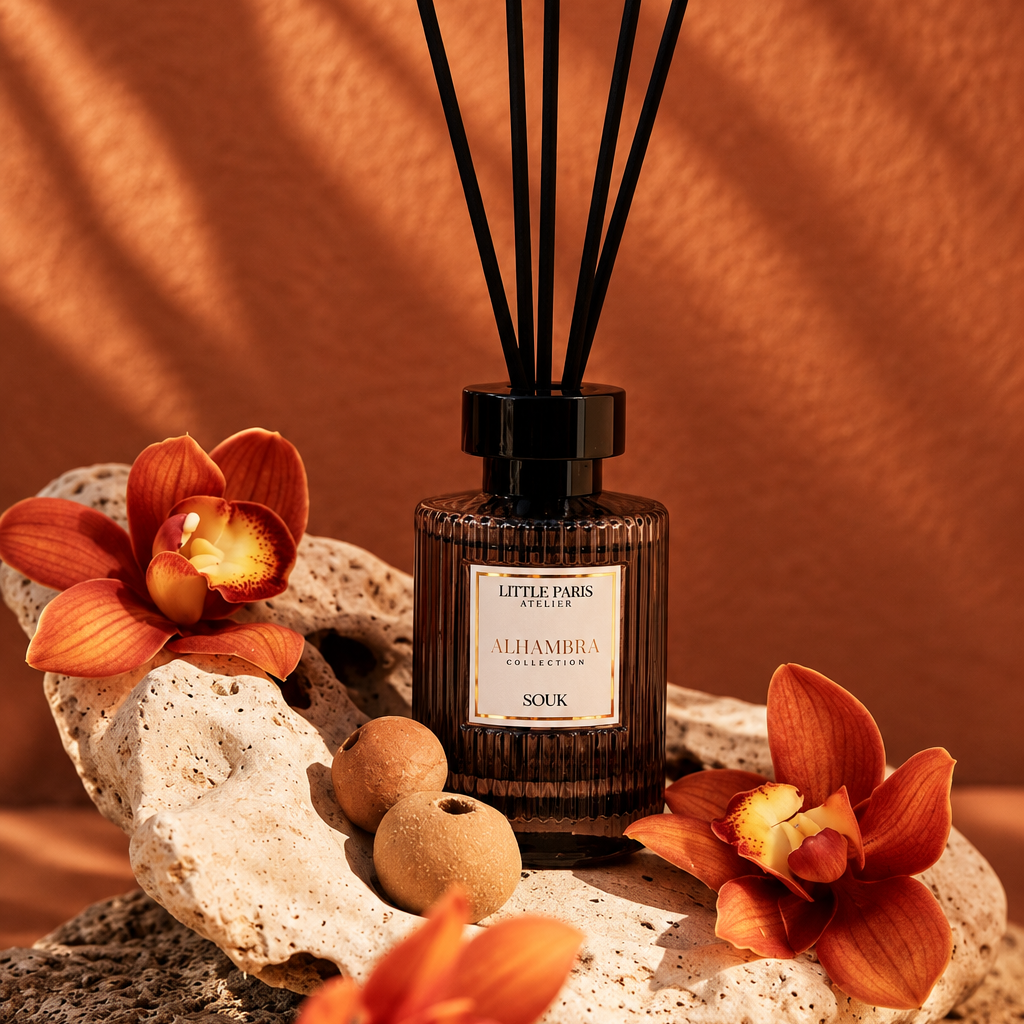

Fragrance notes 101: how to read a scented candle like a professional
A well-built candle does not tell you everything in the first minute. Like a good perfume, it reveals its story in stages.
The short answer
Fragrance notes are the three layers that make up any perfume. Top notes appear in the first 5 to 15 minutes; they are volatile and often citrus. Heart notes build the core of the fragrance between 15 minutes and 2 hours; they are floral and fruity. Base notes last for hours and give depth; they are woody, amber, musky. Together they form the fragrance pyramid, the fundamental structure of every well-built perfume.
Why a candle has three different moments
When you light a scented candle, you do not receive the whole fragrance at once. First come the most volatile notes, the small molecules that evaporate quickly. After a few minutes they fade, and behind them the heavier notes, which diffuse more slowly, begin to rise to the surface. In the end, only the notes with the highest molecular weight remain, and they linger longest.
This is the fragrance pyramid, the fundamental concept of classical perfumery. It was formalised in the nineteenth century and still holds today, because it comes down to the physics of molecules, not to fashion. Perfumers use it when composing a new scent. And you can use it when choosing a candle.
We build Little Paris Atelier candles around this structure. The notes are listed on every product in the order in which they appear, so you can read a candle like a musical score before you even light it.
A 2-minute exercise
Try this at home.
Light a candle.
Smell it after 5 minutes.
Smell it again after 30 minutes.
Do it once more after 2 hours.
If you notice three different scents, you have just discovered the fragrance pyramid.
Act I: top notes (the first 5 to 15 minutes)
They are the first impression, the greeting. Top notes are almost always citrus, aromatic or fresh and fruity. Their molecules are small, they evaporate very quickly and they fade in less than a quarter of an hour. Their role is to seduce you instantly, to make you want to stay close to the flame.
Common top notes: lemon, bergamot, grapefruit, mandarin, neroli, pomelo, lime, mint leaves, fig leaves, fresh green leaves, rhubarb, rosemary.
A few candles from our collection that show exactly what dominant top notes mean:
- Champagne, with grapefruit, pomelo and rhubarb, is built almost entirely on top notes. The feeling that a bottle of prosecco has just been opened comes from the liveliness of these volatile molecules.
- Herbes d'Or, with sage, petitgrain and lemon, is a top-note composition in a herbal key. Petitgrain is distilled from the leaves of the bitter orange tree: it has the same sparkle as a citrus note, but with a green depth.
- Cosy Morning, with lemongrass, ginger and vanilla, uses lemongrass as its top note. It is the scent of an Asian café in the morning.
- Maison d'Oranger, with neroli, mandarin and yuzu, demonstrates top notes in a floral citrus register. Neroli is one of the most precious notes in perfumery.
How to recognise a candle rich in top notes: you can smell it before you even light it, just by opening the vessel. And in the first minutes of burning, the scent is intense, almost explosive.
Act II: heart notes (15 minutes to 2 hours)
Once the top notes fade, the heart of the fragrance emerges behind them. Heart notes, also called middle notes, are the ones that truly define a candle. They are almost always floral, sweet and fruity or richer greens.
Common heart notes: rose, jasmine, freesia, magnolia, hyacinth, lily of the valley, peony, linden blossom, peach, plum, pear, apple, honey, red berries.
A few candles where the heart notes are the hero:
- Slow Sunday, with pear, freesia and musk, is a lesson in how a fruity heart note combines with a floral one to create a new scent, greater than the sum of its parts.
- We Meet Again, with hyacinth, lily of the valley and peach, is built almost entirely on floral and fruity heart notes. The scent changes dramatically after the first 20 minutes, when the peach steps in front of the hyacinth.
- May in Bloom, with linden blossom and honey, shows how one heart note (honey) supports and brings to the surface another heart note (linden blossom) that would otherwise be lost.
- Impassioned Plum, with plum, nutmeg and patchouli, uses plum as a fruity heart note that then meets a woody patchouli base.
Heart notes are what you smell most when you have friends over and the candle has been burning for an hour. They are the scent your guests carry home in their clothes.
Act III: base notes (hours, the finale)
Base notes are the foundation. They give a fragrance depth, staying power and character. They are almost always woody, amber, animalic or balsamic. Their molecules are heavy, they evaporate very slowly and they stay in the room for hours after the flame is out.
Common base notes: cedarwood, sandalwood, agarwood (oud), vetiver, patchouli, musk, amber, ambergris, tobacco, vanilla, tonka bean, saffron, leather.
A few candles where the base notes define the identity:
- A Love Letter, with Damask Rose and Agarwood, is built like an oriental perfume. The rose is the heart note, but the agarwood is the hero. It lingers in the room for hours after the candle has been put out.
- Nocturne, with oak wood, saffron and vanilla, is almost entirely base. Saffron is one of the most precious base notes in perfumery, at once metallic and sweet in its depth.
- Velvet Noir, with cedarwood, lavender and amber, uses cedarwood and amber as its base structure, while lavender is the heart note that weaves them together.
- Downtown Baby, with tobacco, vanilla and tonka bean, is a lesson in base notes in a gourmand register. All three are base notes: the candle is almost entirely dry-down.
- Spicy Romance, with sandalwood, black pepper and amber, uses black pepper as a bridge from top to base, with sandalwood and amber as the fundamental structure.
How to recognise a candle rich in base notes: the scent grows stronger, not weaker, after an hour of burning. And it stays in the room long after you have put out the flame.
Table: the three acts at a glance
| Layer | Duration | Typical families | LPA examples |
|---|---|---|---|
| Top | 5 to 15 minutes | Citrus, aromatic, green leaves | Champagne, Herbes d'Or, Cosy Morning, Maison d'Oranger |
| Heart | 15 min to 2 hours | Floral, sweet fruity | Slow Sunday, We Meet Again, May in Bloom |
| Base | Hours | Woody, amber, musk, gourmand | A Love Letter, Nocturne, Velvet Noir, Downtown Baby |
Expert note
In perfumery, the final phase of a scent is called the dry-down. It is the moment when the top and heart notes have completely faded and only the base notes remain, in a more concentrated and more honest form. The dry-down is the real test of a candle. A well-built fragrance has a pleasant dry-down, woody or amber. When you try a new candle, let it burn for two hours before deciding whether you like it.
How to use this when you buy a candle
Now that you know the pyramid, you can read a candle like a score. A few questions to ask before you buy:
Does the candle have all three layers? A well-built candle usually has one top note, one or two heart notes and one base note. If all the notes belong to the same family, the fragrance will feel linear, with no evolution. If you want a scent that changes over the hour, look for a complete pyramid.
What time of day is the candle for? For mornings, choose something with strong top notes, to give you a quick lift. For evenings, choose something with rich base notes that build the atmosphere of a day drawing to a close. For hosting, choose something with a strong heart, because that is where most of the fragrance plays out while you have guests.
How do you test a candle? The cold throw (the scent of the unlit candle) mostly tells you about the top notes. For the heart and base, you need to light it and wait. Cold throw can be misleading, because candles rich in base notes seem more discreet when cold and only reveal their full intensity once the flame warms the wax. The scent is the same; it simply becomes more present in the room as the burn progresses.
Wax quality is one of our constant priorities in our Bucharest atelier, because the type of wax influences how well each layer of the pyramid diffuses. A poor wax loses the heart and base notes faster, because the burn is uneven.
Next time you light a candle, do not try to identify every note in the first minute.
Let it speak to you.
The most interesting scents are never in a hurry.
Discover Little Paris Atelier
Now that you know the pyramid, build your own
In our Bucharest atelier we host three-hour workshops where you create your own candle. You choose the top, heart and base notes, blend them in the proportions you love, we pour them together and you leave with a one-of-a-kind candle with your name on the label. If your travels bring you to Bucharest, we would love to welcome you.
See the Candle WorkshopFrequently asked questions about fragrance notes
Why does a candle's scent change after an hour of burning?
Because the top notes, made of small, volatile molecules, evaporate first. Behind them come the heart notes and then the base notes, whose molecules are larger and diffuse more slowly. This is not a flaw in the candle; it is its very structure. A well-built candle evolves in three distinct acts.
Which layer of the pyramid matters most?
The heart notes. They are the core of the fragrance and truly define a candle's character. Top notes are the first impression and fade quickly. Base notes give depth and staying power. But the heart is what stays in your memory as the signature scent of that candle.
How do you test a candle properly before buying it?
Smelling it straight from the closed vessel (the cold throw) mostly shows you the top notes. For the heart and base, the candle needs to be lit and left to burn for at least 30 minutes, ideally two hours. The dry-down (the finale) is the real test. If it seems just as pleasant, or more so, after two hours, it is a well-built candle.
Do all candles have a three-layer fragrance pyramid?
Technically, yes. Any blend of fragrance oils contains molecules of different weights, so it will behave like a pyramid. The difference is intention. A cheap candle may have a pyramid by accident, with no balance between the acts. We design our fragrances with every note chosen for its role in the evolution.
What does it mean when a candle lists only two notes on the label?
It means the maker has chosen to simplify the message, but the fragrance still has a complete structure underneath. At Little Paris Atelier we list three notes for every candle, to make clear which ones dominate each layer of the pyramid. That does not mean the scent contains only three molecules, but that three are the leading characters.

