
Vanilla in perfumery: from Shalimar to the art of scenting the home
Vanilla has a reputation as a sweet, almost predictable note. But before it became the scent of cakes and childhood memories, it was a tropical orchid, a rare material and an ingredient capable of giving fragrances depth, warmth and even a certain darkness.
The short answer
In perfumery, vanilla can smell creamy, balsamic, amber, spicy, woody or gourmand. The natural material comes from the fruit of orchids of the genus Vanilla, especially Vanilla planifolia. Vanillin is one of the key molecules of its scent, but on its own it does not reproduce the full complexity of the pod. In contemporary fragrances, vanilla may appear as a natural extract, a single molecule or an accord built from several ingredients.
Vanilla does not begin in a kitchen, but in an orchid
Vanilla has its origins in tropical America, and Vanilla planifolia is closely linked to the history and growing practices of Mexico. Unlike the familiar image of dried pods, the plant is a climbing orchid, with delicate flowers that open for only a very short time. The green fruits do not yet have the rich scent we associate with vanilla.

Vanilla planifolia, the tropical orchid whose fruit gives us vanilla.
After harvesting comes a slow transformation: successive stages of heating, sweating, drying and conditioning, depending on the local method. It is during this stage that the recognisable aromatic profile of the pods develops. The scent of vanilla is, in a very concrete sense, the result of time and human labour.
Worth remembering
"Bourbon" vanilla contains no bourbon whiskey. In the vanilla trade, the term has historically been associated with production in the Indian Ocean region, including Réunion and Madagascar. It does not automatically describe a boozy note.
How vanilla smells, beyond sweetness
If you smell a good-quality vanilla pod, you will discover more than sugar and cream. Balsamic, woody, slightly smoky, spicy or even dried-fruit facets may appear. The profile varies with species, provenance and curing.
In a composition, the same idea of vanilla can become a delicate cream, a warm amber, a dessert fresh from the oven or a dark base next to tobacco and wood. The difference lies not only in the amount of vanilla, but above all in the materials that surround it.
Natural vanilla, vanillin and ethyl vanillin: what is the difference?
| Material | Olfactory character | Role in perfumery |
|---|---|---|
| Vanilla extract / absolute | Complex, balsamic, with nuances of pod and dried fruit | Adds depth and texture |
| Vanillin | Sweet, warm, familiar | Builds the recognisable vanilla character |
| Ethyl vanillin | More intense, with a pronounced creamy, sweet effect | Accentuates vanilla and gourmand accords |
None of these options, on its own, guarantees a better fragrance. A vanilla accord can be built from several ingredients, natural or synthetic, and the result depends on the balance of the whole formula. Nor does the mention of "Madagascar vanilla" in an olfactory pyramid prove, by itself, the presence of a natural extract from that origin.
Expert note
Vanillin is an important molecule in the aroma of the pod, but the natural scent of vanilla cannot be reduced to vanillin. This very difference explains why a cured pod can seem more complex and less "sugary" than a simple accord built entirely around a single molecule.
Why vanilla is not necessarily a gourmand fragrance
In the language of perfumery, gourmand describes accords that evoke food, desserts or edible ingredients. Vanilla appears frequently in this family, but it can also play an entirely different role: it can soften a dry wood, warm an amber composition or bind tonka, resins and tobacco into a velvety base.
Combined with citrus or white flowers, vanilla can become luminous. Alongside spices, nuts and caramel, it becomes comforting. Next to tobacco and woody notes, it takes on a more restrained sensuality. There is no single vanilla.
From the perfumery archives
Shalimar: vanilla before the gourmand era
Long before vanilla became the protagonist of contemporary gourmand fragrances, it had earned its place in the great creations of perfumery. Launched in 1925, Shalimar by Guerlain, created by Jacques Guerlain, remains a landmark of the amber family. The brilliance of bergamot meets powdery, resinous accents and a warm, deeply sensual vanilla base. Here, vanilla does not evoke a cake, but elegance, warm skin and mystery.
Shalimar reminds us that the fascination with vanilla did not begin with recent trends. What changes is the way perfumers choose to interpret it.
Why is vanilla back at the centre of niche perfumery?
Vanilla has never disappeared from perfumery. What has changed is the way it is interpreted. Instead of an exclusively sweet vanilla, reminiscent of sugar and desserts, perfumers today experiment with contrasts: salt, dry wood, musk, tobacco, resins or even mineral accords.
It is one of the important directions of contemporary perfumery: the gourmand is becoming less literal and more sophisticated. A vanilla fragrance can have the familiar warmth of a dessert, but also the air of a library with wooden furniture, of a hotel room or of a fine fabric worn close to the skin.
In niche perfumery, this freedom of interpretation is particularly interesting. Vanilla no longer has to be the main character: it can support a leather note, soften an austere wood or bring depth to a musk accord. Its current popularity owes as much to its familiarity as to the possibility of reinventing it.
Worth remembering
Modern vanilla is not necessarily less sweet, but more diverse. Some creations remain gourmand, others use vanilla for texture, contrast and depth.
From gourmand vanilla to the fragrance that feels like a second skin
One of the most interesting transformations of contemporary vanilla is the way it has moved beyond the exclusive register of desserts. In some fragrances it no longer evokes a cake, but the warmth of skin, the texture of a soft fabric or the discretion of a fragrance worn very close to the body. Musk, sandalwood and amber can temper its sweetness, while saffron, nutmeg or patchouli give it a bolder expression.
An interesting example is the way the fragrance house Commodity explores the same olfactory idea in several intensities: a skin-close vanilla, a richer amber one and a spicy interpretation. These are not three different ingredients, but three ways of building an atmosphere around vanilla.
Expert note
In perfumery, a "vanilla note" is not synonymous with pod extract. It can also mean an accord created from several materials. That is why two fragrances described as vanillic can have radically different personalities.
How does vanilla smell in a home?
In a room, vanilla is not perceived merely as an individual note. It enters into dialogue with the size of the space, the temperature, the ventilation and the other smells around it. In a creamy composition it can suggest comfort and intimacy; alongside spices it can evoke a kitchen where something has just been baked; combined with wood, amber or tobacco it can create a more restrained, almost cinematic atmosphere.
What matters is balance. In a small room, a very sweet and intense fragrance can become tiring, while an airier or woodier vanilla can be easier to live with. There is no universal rule: perception depends on the complete formula, not just on the presence of vanilla.
Vanilla and the gourmand world at Little Paris Atelier
In our collection, vanilla changes personality from one composition to the next. From creamy accords to compositions with tobacco and tonka, each fragrance offers a different atmosphere.
Elixir Vanilla
In Elixir Vanilla, Madagascar vanilla meets nutmeg, almonds and buttery accents, in a composition that opens onto white flowers, caramel and musk. The result is an ample, creamy and spicy vanilla, with a velvety floral texture.
Carrot Cake
In Carrot Cake, vanilla sits beside the aroma of carrot cake and pecans. It is its most comforting interpretation: spicy, warm, with the air of a cake just out of the oven.
Secrets in the Oven
Secrets in the Oven brings vanilla together with baked apples, caramel and cinnamon. The warm fruit and spices turn the vanilla note into a patisserie atmosphere, familiar and welcoming.
Pâtisserie
Pâtisserie explores a related gourmand direction, built around pecans, cocoa powder and honey. It is not strictly an interpretation of vanilla, but a contrast that shows how differently the sensation of dessert can be built in a home fragrance.
Downtown Baby
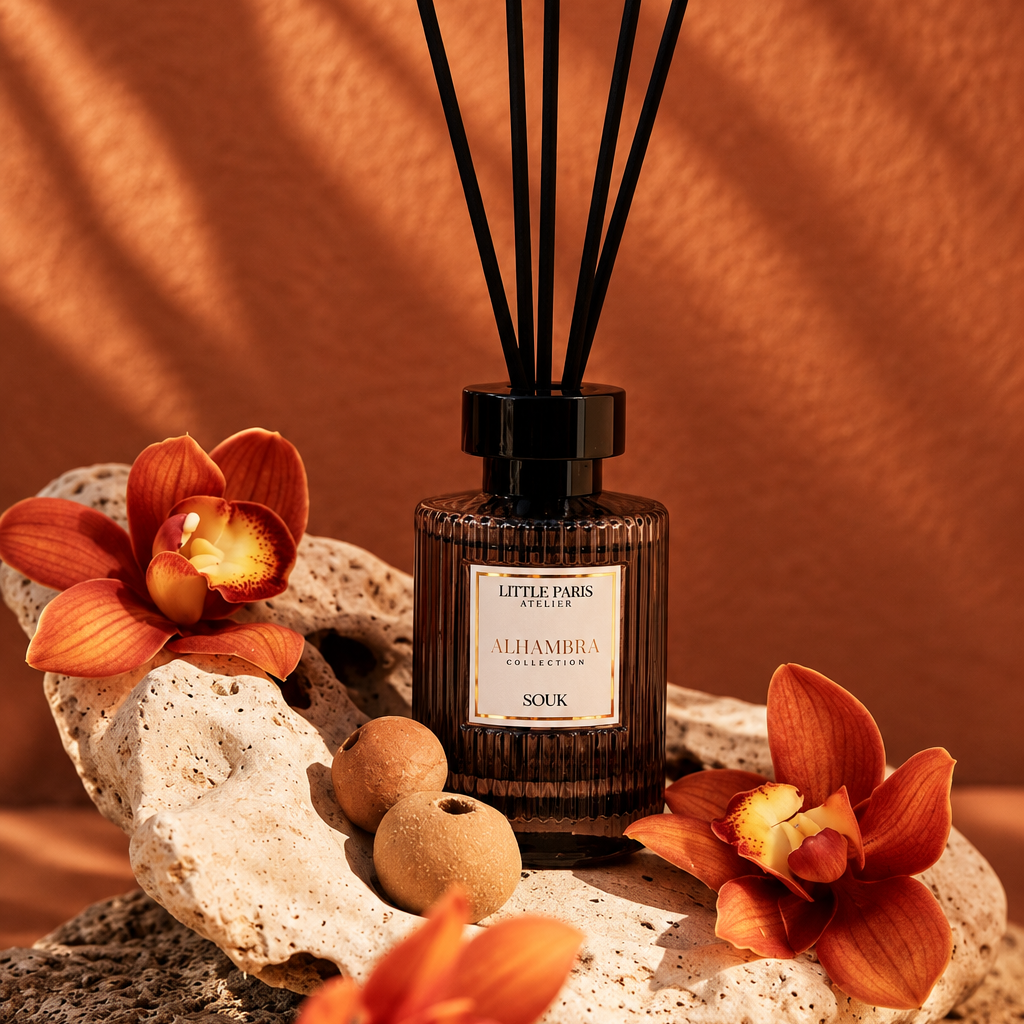
In the Downtown Baby diffuser, vanilla reveals a darker side, alongside tobacco and tonka bean. It no longer evokes a dessert, but a warm, sensual, urban atmosphere.
The art of layering: how to combine vanilla with other fragrances at home
In perfumery, layering means overlapping fragrances to achieve a personal expression. At home, the principle can be explored through the discreet meeting of a candle and a diffuser, or by alternating scents that gradually change the atmosphere. Vanilla is a versatile starting point: it can be softened with green notes, brightened with citrus or deepened with wood and spices.
Vanilla and citrus: sweetness gains light
The creaminess of Elixir Vanilla can be set in contrast with the citrus, spicy freshness of Cosy Morning. Vanilla stays present, but the overall feeling can become airier and livelier. It is a combination to try when you want warmth without too sweet an effect.
Vanilla and smoky wood: a deeper atmosphere
Alongside the burnt wood and clove accents of Night at the Chalet, Elixir Vanilla can take on a darker side. The contrast between creamy and smoky recalls the way niche perfumery uses vanilla to bring softness to more austere woody accords.
Vanilla, tobacco and tonka: contrast with a green note
Downtown Baby already offers a warm vanilla, alongside tobacco and tonka. For an interesting contrast, you can try nearby, though not necessarily at the same time, a green accent from Orto di Luce, with basil, tomato leaf and bergamot. The vegetal green can make the vanilla base feel less sweet and more contemporary.
Expert note
Layering at home does not mean lighting two candles at the same time. A diffuser can create a constant olfactory backdrop, while a candle can temporarily add another nuance. Start with low intensities and notice how the scents meet: the suggestions above are ideas to explore, not combinations tested as single formulas. Never leave candles unattended, and keep diffusers away from children and pets.
A home does not always have to smell the same. Sometimes changing a single note is enough to transform the atmosphere. And vanilla, precisely because of its versatility, can become the starting point of a personal olfactory signature.
Discover Little Paris Atelier
Vanilla, in all its nuances
From creamy, delicate vanilla to spicy or dark accords, discover the scented candles and diffusers created in our Bucharest atelier.
Discover the candlesFrequently asked questions about vanilla
Where does vanilla come from?
Vanilla comes from the fruit of tropical orchids of the genus Vanilla, especially Vanilla planifolia, a species historically associated with Mexico and Central America.
Does natural vanilla only smell sweet?
No. Depending on provenance and curing, it can have balsamic, woody, spicy or slightly smoky facets, in addition to its familiar sweetness.
What is the difference between vanilla and vanillin?
Natural vanilla is a complex material, with numerous aromatic compounds. Vanillin is one of its main molecules and can be used on its own in perfumery.
Which other home fragrances pair well with vanilla?
Citrus can give it freshness, green notes can temper its sweetness, and wood and spices can heighten its depth. Start with a single source of fragrance and gradually add a second scent, to avoid an overly intense blend.
Are there vanilla fragrances that do not smell of cakes?
Yes. Combined with tobacco, wood, amber, resins or flowers, vanilla can become restrained, sensual, floral or balsamic, without an obviously gourmand character.