
Neroli vs orange blossom: what is the difference and how do they smell?
The same flower, the same tree, two surprisingly different olfactory interpretations. Neroli and orange blossom absolute are both born from the blossoms of the bitter orange tree, but the extraction method changes their expression: one is luminous and airy, the other rich and sensual.
The short answer
Neroli is the essential oil obtained by distilling the blossoms of the bitter orange tree: floral and fresh, with citrus and green accents and sometimes a slightly soapy touch. Orange blossom absolute is obtained by solvent extraction and generally has a denser, honeyed and sometimes indolic character. Both come from Citrus aurantium, but the processes used to obtain them select the aromatic compounds differently.
One orange tree, four fragrant materials
The bitter orange tree, Citrus aurantium, gives perfumery several materials with distinct personalities. It is not only the part of the plant that matters, but also the way the aroma is extracted.
| Material | Source and method | Olfactory profile |
|---|---|---|
| Neroli | Blossoms, steam distillation | Floral, luminous, citrus, green |
| Orange blossom absolute | Blossoms, solvent extraction | Rich floral, honeyed, warm, sometimes indolic |
| Petitgrain | Leaves and young twigs, distillation | Green, bitter, aromatic, woody |
| Bigarade | Peel of the bitter orange fruit, cold pressing | Citrus, bitter, fresh, slightly green |
There is also orange flower water, the aromatic aqueous phase left over from distillation, known above all in cooking and cosmetics. It should not be confused with neroli essential oil.
Where does the name neroli come from?
The name is linked to the Princess of Nerola, a seventeenth-century aristocrat associated with popularising the essence of orange blossom in European perfumery. The exact story behind the name exists in several historical versions, but the connection with Nerola, near Rome, has endured. Beyond this history, neroli became one of the emblematic notes of the eau de cologne tradition, where it meets bergamot, lemon and other aromatic notes.
Why do neroli and the absolute smell different?
Neroli: the light of distillation
In steam distillation, the vapour carries away some of the aromatic compounds of the blossoms. The resulting oil often has a particular transparency: floral, fresh and slightly green, with citrus facets and a delicacy that can recall fine soaps. Its composition may include, among others, linalool, limonene and linalyl acetate; the proportions vary with origin and batch.
The absolute: the depth of the flower
Solvent extraction recovers a different profile of aromatic substances. Once the concrete has been obtained and processed, the result is the absolute: a material often warmer and more voluptuous, with accents of honey and white flowers. It may also show indolic nuances, which add naturalness and depth.
Expert note
Indole is present in the profile of some white flowers and, depending on its concentration, can give a naturalistic floral facet or an animalic one. This does not mean that every orange blossom absolute smells animalic, nor that neroli is entirely free of such nuances. Natural materials differ from one batch to the next.
Why are they so highly prized?
The blossoms are delicate, harvesting demands care, and the amount of aromatic material obtained is small relative to the mass of flowers processed. Yields depend on origin, growing conditions and extraction method. That is precisely why neroli and natural orange blossom absolute are valuable materials.
In contemporary perfumery, creators use both natural extracts and accords reconstructed from aromatic ingredients. These are not automatically an inferior version: they can offer stability, different creative possibilities and a well-controlled olfactory profile.
How to recognise them when you smell them
The best exercise is to compare the two materials on smelling strips, at suitable dilutions, without hurrying.
The sense of light. Neroli is often airier, more citrus and greener; the absolute can feel warmer and broader.
The texture. Neroli suggests fresh petals and a delicate cleanliness; the absolute can evoke honey, pollen and the density of a white flower.
The evolution. Both change over time. Intensity and longevity depend on concentration, the medium and the rest of the formula, not just on the name of the material.
How they are used in perfumery
Neroli often appears in the opening of citrus and aromatic compositions and in modern interpretations of eau de cologne. It can also bring freshness to the heart of a floral fragrance. Orange blossom absolute is often used to build a richer floral heart, alongside jasmine, tuberose, amber or woody notes.
In home fragrance, this difference can inspire distinct atmospheres: a luminous one, with citrus and airy flowers, or a warmer one, with white flowers and velvety notes. There is, however, no "obligatory" room for either; what matters is the complete composition and the preferences of those who live there.
Orange blossom in the world of Little Paris Atelier
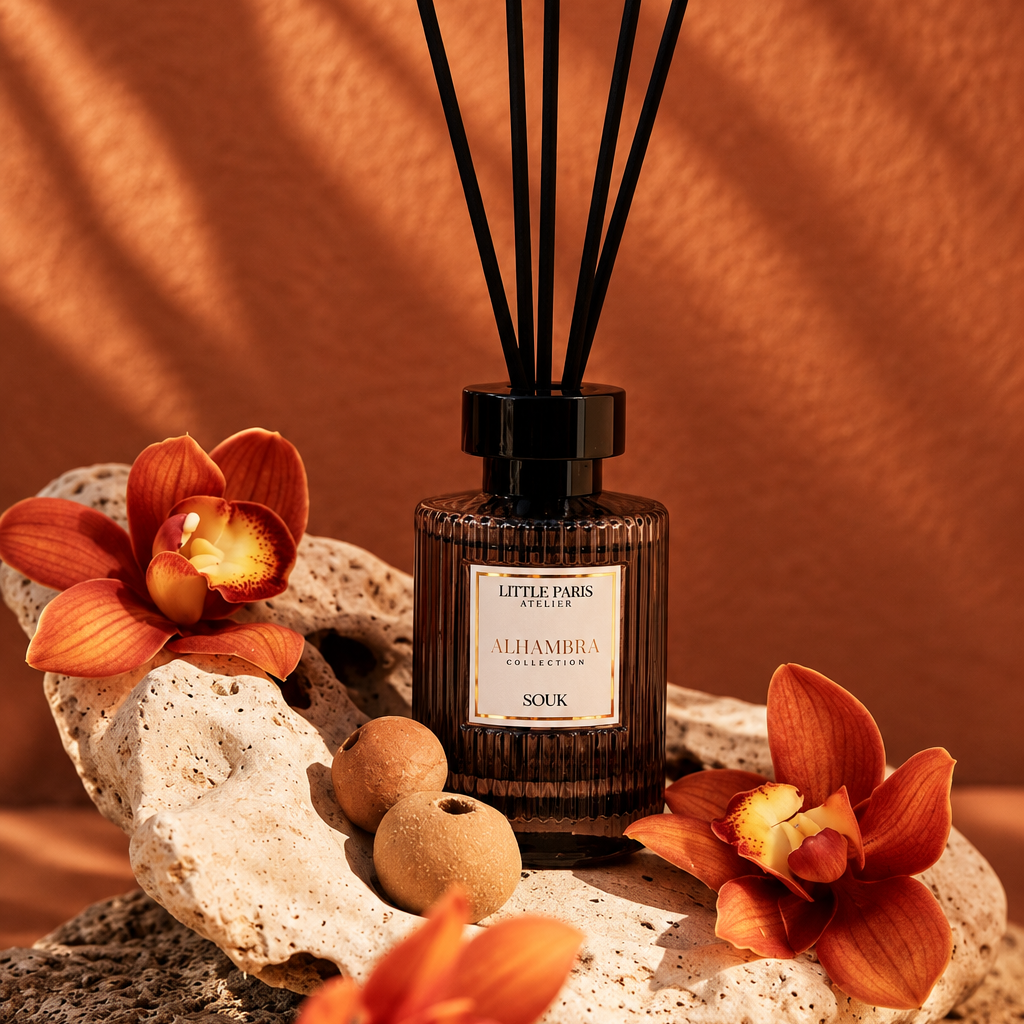
In Azahar, the diffuser from the Alhambra collection, orange blossom and neroli are set in dialogue with honey, lemon and other white flowers. The result is a luminous floral interpretation, with a delicate warmth in the background. Its name, azahar, is also the Spanish word for orange blossom: a natural reference to the Andalusian gardens and courtyards that inspired the collection. The listed notes describe the character of the fragrance, without necessarily indicating the presence of natural neroli or orange blossom extracts.
Maison d’Oranger explores the luminous side of neroli. Mandarin, yuzu and bergamot open the composition, while neroli meets lavender and lily. In the base, sandalwood, musk and caramel offer a discreet warmth. It is the olfactory image of a sun-drenched Mediterranean garden.
To understand the green register by contrast, Orto di Luce, with basil, tomato leaf and bergamot, offers a vegetal freshness quite different from the floral freshness of neroli. And May in Bloom, with linden blossom and honey, explores another expression of warm, honeyed florals. These are comparisons of atmosphere, not equivalents of orange blossom absolute.
For another expression of orange blossom, Azahar also exists as a scented candle. You can discover more compositions in the Little Paris Atelier candle collection and in our selection of room diffusers.
Discover Little Paris Atelier
A garden of scents, at home
Hand-poured soy wax candles and room diffusers created in our Bucharest atelier. Floral, citrus and woody compositions that give every space its own personality.
Discover the candlesFrequently asked questions about neroli and orange blossom
Are neroli and orange blossom absolute the same thing?
No. They come from the blossoms of the same bitter orange tree, but are obtained by different methods. Neroli is usually fresher and airier, the absolute denser and more honeyed.
What is petitgrain?
An essential oil obtained mainly from the leaves and young twigs of the bitter orange tree. It has a green, aromatic and slightly bitter profile, different from that of the blossoms.
Why is neroli expensive?
Because the blossoms require careful harvesting and the yield of essential oil is low. The price varies with origin, harvest and quality.
What does an indolic floral note mean?
It is an olfactory facet associated with indole, a compound that can give white flowers an intense, naturalistic and sometimes animalic feel, depending on the dosage.
Is neroli only for summer?
No. Its luminous character makes it popular in the warm season, but it can be worn or used in home fragrances all year round.